



Celebrating Black History Month
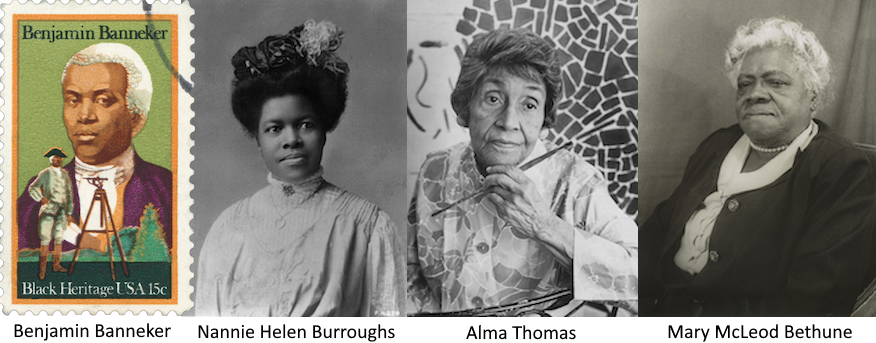
As we celebrate Black History Month, NNV reflects on the influential Black leaders whose names adorn DC’s streets and parks.
Benjamin Banneker was an African American mathematician and astronomer who assisted chief surveyor Andrew Ellicott in mapping out the District of Columbia’s boundaries. Banneker spent almost a year on the survey and then created an almanac of Pennsylvania, Delaware, Maryland and Virginia, which was published in 1792. In recognition of Banneker’s achievements and contributions to our city, Benjamin Banneker Park in Southwest DC was named in 1971. There is also a street named Banneker Drive, NE, and Banneker High School in Northwest.
Nannie Helen Burroughs was born to a formerly enslaved couple. Burroughs excelled in school and graduated with honors from M Street High School (now Dunbar High School). Despite her academic achievements, Burroughs was turned down for a D.C. Public School teaching position. Undeterred, Burroughs decided to open her own school to educate and train poor, working African American women. Unwilling to rely on money from wealthy white donors, Burroughs gathered small donations from Black women and children in the community, raising enough money to open the National Training School for Women and Girls, now a National Landmark in Northeast, DC. In recognition of Burroughs’ advocacy for greater civil rights and education for African American women, Nannie Helen Burroughs Ave, NE is named after her.
Renowned abstract painter Alma Thomas lived most of her life on the street that bears her name. Alma Thomas Way signs can be found on the corners of 15th and Church St., NW and 15th and Q St., NW. Alma Thomas was the first graduate of Howard University’s art department. She then dedicated over three decades to teaching art at Shaw Junior High School in Washington, DC. Thomas found international success after her retirement, including becoming the first African American woman to hold a solo exhibition at the Whitney Museum of American Art in New York City.
Mary McLeod Bethune’s memorial statue stands proudly in Lincoln Park in Capitol Hill. The 1974 memorial was the first to honor an African American woman on public land in DC. Bethune founded the National Council of Negro Women (NCNW), a powerful organization that united a variety of African American women’s groups for Civil Rights. Over the years, NCNW ran operations from Bethune’s apartments and homes including her rowhouse in Logan Circle, which is now a National Landmark. Additionally, Mary McLeod Bethune established a school for African American girls, known today as Bethune-Cookman University in Daytona Beach, Florida, and was an advisor to four U.S. Presidents.
In addition to the remarkable historical figures mentioned here, well-known Black leaders like Frederick Douglass, Martin Luther King, Jr., and Malcolm X have landmarks named after them throughout the city. Earlier, the Smithsonian had an exhibit called Block by Block: Naming Washington. While the physical exhibit is no longer at the Smithsonian, you can learn more by clicking here.